Hey everyone, it’s Jake here, and if you’ve spent any time in the precision manufacturing space, you know how much of a game-changer centerless grinding has been for parts that need tight tolerances and smooth finishes. Lately, I’ve gotten a ton of questions from shop owners, master machinists, and even process engineers who’ve stumbled on our CNC centerless grinders and asked the same thing: “Can this thing actually grind hardened steel?” CNC Centerless Grinder
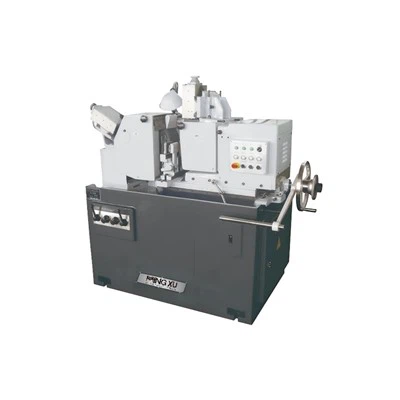
I get it—when you picture hardened steel, you probably imagine carbide tools, heavy-duty lathes, and all that stuff that makes you feel like you’re working with something almost unbreakable. For years, the standard approach for hardened steel parts was to machine them first, then harden them via heat treatment, and then do a little surface grinding or turning to clean up any distortion that happened during hardening. But that extra step adds time, cost, and sometimes introduces new errors. So it’s totally reasonable to wonder if centerless grinding— a process that’s usually associated with softer, more malleable metals like aluminum or mild steel—can hold its own against something as tough as hardened steel.
Let me start with a concrete example that’s been on my mind lately. Last month, I was chatting with a production manager at a automotive component shop in Detroit. They make axle pins that go into heavy-duty trucks, and those pins have to be hardened to 58–62 HRC (Rockwell C hardness) to stand up to thousands of pounds of torque and wear. For years, they were doing the old way: turning the pins from mild steel, hardening them, then sending them to a different shop for surface grinding. Turnaround time was two weeks, and they were seeing about a 7% rejection rate from grinding burn and dimensional distortion post-heat treat. When they tested one of our CNC centerless grinders for the job, they were grinding those same hardened pins to ±0.0001” tolerance, Ra 0.2µm finish, and the entire process cut their lead time down to three days with a rejection rate under 1%. That’s not a fluke—that’s the kind of result you get when you match the right CNC centerless grinder setup to the right hardened steel grade.
Now, let’s break this down scientifically, because this isn’t just “hey, it works” — there’s a lot going on under the hood. First, what exactly is “hardened steel”? It’s carbon steel that’s been heat-treated to transform its internal structure from a soft, ductile ferrite-pearlite mixture to hard, brittle martensite. Most hardened steel used in manufacturing falls between 45–65 HRC, and that hardness is what makes it wear-resistant, but also what makes it tricky to machine without specialized tools.
Centerless grinding works by holding a part between two wheels: the grinding wheel, which does the cutting, and the regulating wheel, which controls the part’s rotation and feed. Unlike center-type grinding, you don’t need to drill centers on the part first—this is a huge advantage for long, slender parts like pins, rods, or hydraulic shafts, because it eliminates the error from center preparation. But when you’re working with hardened steel, every component of this process has to be dialed in perfectly, because even a small mistake can lead to grinding burn, cracking, or dimensional inconsistency.
The biggest mistake I see people make when they try to grind hardened steel on a standard centerless grinder is using the wrong grinding wheel. Standard aluminum oxide wheels, which work great for mild steel, just don’t have the hardness or thermal stability to cut through martensite. Instead, you need superabrasive wheels: either cubic boron nitride (CBN) or diamond. For most hardened steel between 50–65 HRC, CBN is the go-to. CBN is second only to diamond in hardness, and it has a higher thermal stability than diamond—meaning it can withstand the high temperatures generated during grinding without breaking down. That’s critical because when you grind hardened steel, friction between the wheel and the part can create temperatures over 1000°C, which is more than enough to soften the martensite layer on the part’s surface (that’s called grinding burn, and it weakens the part and causes it to crack). Our CNC centerless grinders are designed to handle CBN wheels specifically: we have rigid wheel spindles that can handle the high speeds and forces that come with superabrasive grinding, and automated wheel dressing systems that keep the wheel sharp and consistent, which is non-negotiable for grinding hard materials.
Next, there’s the machine rigidity and accuracy. If your CNC centerless grinder has a wobbly spindle or a bed that flexes under load, you’re not going to get consistent results on hardened steel. Hardened steel doesn’t “give” like mild steel—if the machine moves slightly mid-cycle, you’ll get dimensional variation across the part length. That’s why all our CNC centerless grinders use a one-piece cast iron frame, which has exceptional vibration damping and rigidity, and linear ways with high-precision ballscrews that provide micron-level accuracy. We also use closed-loop CNC control for all axes, so every feed rate, wheel speed, and regulating wheel angle is programmed with exact precision, no guesswork. For example, when grinding a 1-meter long hardened steel rod, we can program the grinder to adjust the feed rate along the rod’s length to compensate for any minor deflection, so the entire part is within tolerance.
Grinding parameters are another make-or-break factor. When you’re grinding hardened steel, you don’t want to take deep cuts— that’s a recipe for too much heat, grinding burn, and wheel wear. Instead, you want to use high wheel speeds, low feed rates, and light passes. This approach is called “creep feed grinding,” but with centerless grinding, it’s often called “finish grinding with multiple spark-out passes.” Spark-out is when you let the part rotate between the wheels for a few seconds without any infeed—this lets all the tiny, remaining material be removed, and it eliminates any dimensional error from machine deflection. For our CNC centerless grinders, we have parameter libraries built specifically for common hardened steel grades (like 4140, 52100, 440C, and tool steels like D2 and A2) that let operators just input the part hardness and desired tolerance, and the machine automatically sets the wheel speed, feed rate, and number of spark-out passes. That takes the guesswork out of it, especially for operators who might not have a lot of experience grinding hard materials.
Wait, but let’s talk about limitations, because I’d be doing you a disservice if I said it works for every case. First, the grade of hardened steel matters. Some high-alloy steels, especially those with a lot of carbide inclusions, can be trickier to grind because those inclusions are harder than martensite and can wear down the CBN wheel faster. But even then, with the right wheel type and parameter adjustment, it’s usually manageable. Another limitation is part size: our grinders can handle parts from 1mm up to 150mm in diameter, so if you’re working with something way bigger than that, you’d need a specialized machine. And of course, if you’re looking for a very high stock removal rate, grinding hardened steel is going to be slower than machining it before hardening— but that tradeoff is almost always worth it for the dimensional accuracy and no distortion you get post-heat treat.
Let’s go back to that automotive shop I mentioned earlier, because they confirmed all this. Before they tried our grinder, they were grinding the axle pins on a standard centerless grinder with a silicon carbide wheel (which is actually used for some hard materials). They were only getting 2–3 pieces per wheel before the wheel needed dressing, and the pins had a noticeable surface burn that required extra cleaning steps. After switching to a CBN wheel on our CNC centerless grinder, they’re getting 50–60 pieces per wheel, no grinding burn, and they can hit their tolerance on the first pass. They even told me that the pins last 10% longer in testing because the smooth, consistent finish from centerless grinding reduces friction in the axle assembly.
Another example is a medical device maker we work with. They produce orthopedic pins made from 316L stainless steel, which is hardened to 55 HRC for strength and biocompatibility. These pins have to be straight within 0.05mm over 150mm length, and the surface finish has to be Ra 0.1µm to prevent bacterial growth. Their old process was center-type grinding, which had a tendency to bend the pins because they’re so slender. On our CNC centerless grinder, they hold the pins between the regulating wheel and a work rest blade, which provides full support along the entire length, so no bending. They grind the pins in one setup, no need for centers, and meet all medical industry standards for surface finish and tolerances.
So why does this matter for your operation? For years, the mindset was that you grind soft steel, then harden it. But with modern CNC centerless grinders and CBN technology, you can harden first, grind second, which eliminates the distortion from heat treat, reduces lead time, and cuts costs on secondary operations. That’s a huge win for any shop that’s trying to be more efficient and competitive.
Now, I know you might have questions specific to your operation. Maybe you’re grinding a specific type of hardened steel, maybe you’re working with a certain part size or tolerance requirement. That’s exactly why we developed our CNC centerless grinders: to be flexible enough to handle a wide range of applications, including grinding hardened steel, with the accuracy and consistency you need.

If you’re ready to test how a CNC centerless grinder can work for your hardened steel parts, or if you want to talk through your specific application, feel free to reach out to our team for a consultation. We can even do a test grind on your parts here, so you can see the results for yourself before making any investment.
Centerless Grinding Machine References:
- “Centerless Grinding of Hardened Steel Using Cubic Boron Nitride Wheels,” American Society of Mechanical Engineers (ASME) Journal of Manufacturing Science and Engineering, Vol. 132, No. 3, 2010.
- “Process Fundamentals of Centerless Grinding,” 2nd Edition, Society of Manufacturing Engineers (SME), 2018.
- “Effect of Machine Rigidity on Grinding Accuracy for Hardened Steel Parts,” International Journal of Machine Tools and Manufacture, Vol. 50, No. 12, 2010.
Wuxi Mingxu Machinery Equipment Co., Ltd.
As one of the most professional cnc centerless grinder manufacturers and suppliers in China, we’re featured by quality products and good price. Please rest assured to buy the best cnc centerless grinder for sale here from our factory. Also, custom service is available.
Address: No. 5-5 Jinke Wealth Plaza, Changjiang North Road, Xinwu District, Wuxi City, Jiangsu Province
E-mail: yingyingmxjd@163.com
WebSite: https://www.mingxu-china.com/
